

OTAN News
Designing & Facilitating Student-led Discussions Online
Encouraging in class discussions is challenging enough in a physical classroom. Online discussions can feel “exponentially more difficult” especially when forced and then graded on the response.
Start with Relationships & Clear Expectations
Dr. Catlin Tucker published some helpful ideas to encourage online student-led discussions. She suggests first building a solid, trust-based foundation. To do this, Dr. Tucker establishes expectations with these steps.
- Reflect on Past Experiences
Students think and reflect on speaking up in discussions. When they felt comfortable sharing their thoughts in a class discussion. What made it hard to participate?
- Small Group Norm-Building
Place students in small breakout rooms and ask them to share some of the ideas from Step 1. They post their ideas on a virtual post it wall.
- Share, Select and finalize
Quick discussion about behaviors which matter. Students then vote with emojis, comments, or digital dots. The norms rise to the top and become your online course’s shared agreement.
Build Relationships with Informal Conversations
Informal conversations “aren’t a waste of time”. They are a warmup for the mind, the voice, and the community. Some examples from the article are, “What’s one thing that made you smile this week?” or “What’s your favorite snack?” This is a great way to help students feel not just like learners but as people. When students feel connected and safe, they’re much more likely to talk when there is a deeper conversation.
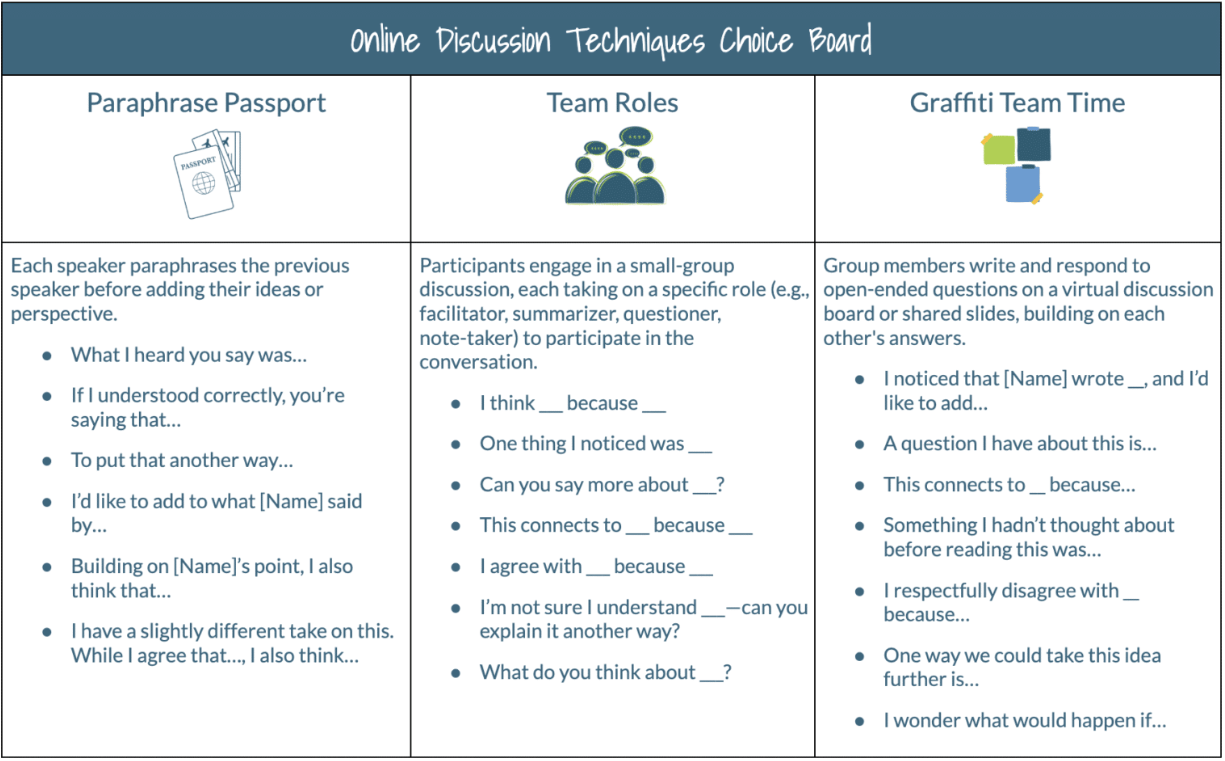
Give Students Agency with a Choice of Discussion Techniques
A choice board works in providing structure and accessible ways to engage in academic conversations. Work groups decide on which discussion technique they would like to employ for the discussion.
There are several other ideas in her full article to foster engaging online discussions.