Using Available Models to Approach an AI Policy in Your Classroom
by Maricel Manglicmot, OTAN Subject Matter Expert

Image from pexels.com
Artificial intelligence is becoming as commonplace as a computer or calculator in the classroom; however, policies vary from school to school and even classroom to classroom. There might not yet be a school-wide AI policy at your site, or your existing policy may need to be further tailored to fit your curriculum. The purpose of this article is to help you begin creating an AI policy that works for you and your class. Although this article leans toward using AI for research and essays, the overarching view can be applied to other classroom uses as well.
Why is an AI policy needed in the classroom?
Whether it’s free use of AI or a moderated one, having a set policy helps create a transparent learning environment for adult students. The following suggestions are for using AI models that are readily available to teachers.
Look back at the standards
Since state standards inform instruction, they can also be used as a guide for how we approach AI in the classroom. How do we address the standards with the assistance of AI as a tool? While the standards don’t specifically mention AI, they do address technology across multiple subject areas– such as using digital tools for citations or collaboration. In this way, the standards give us permission to use AI in the classroom. Narrowing down where AI fits within the standards can help align the practice with your curriculum.
Curriculum
The subject matter curriculum can be used to guide AI policy. As in, which assignments would benefit from appropriate AI use, and which would not? Where can AI be incorporated to build our students’ skills? How often should AI be mentioned?
The use of AI can be interspersed throughout a unit or semester. For example, you might incorporate it into a daily activity such as a conversation-starter. Or, you might dedicate a day for students to use AI on an assignment. This can help students focus on applying it within the parameters of the classroom. When introducing appropriate uses for AI in low-stakes assignments, like warm-ups or journal entries, students could check their spelling or grammar. They might also check that their response answered the question presented in class. In a mathematical perspective, students might ask why their equation is incorrect and AI could help them identify their mistakes.
Finding the best fit for AI in your class will help build consistent expectations. Once it is built into the curriculum, students understand what appropriate use looks like through practice.

Image from pexels.com
Plagiarism policy
Plagiarism becomes a major issue if AI is used to complete students’ assignments for them. How can students demonstrate their knowledge if they have AI do the work for them? Prefacing AI use with a plagiarism policy, whether it be your own or your school’s, can encourage students to demonstrate their own knowledge.
What does AI have to do with plagiarism?
I tell my students that AI is simply another format for presenting information. For example, search engines, like Google, list websites that match the search input, then present them as results with snippets from the websites. AI works similarly by presenting information compiled from online sources or other pre-training models. Some AI responses end with links to websites that helped compile the answer, while others do not.
Since AI retrieves information from somewhere or someone, it’s necessary to give credit to the original sources. If a student borrows information that is not their own original idea, they must cite it. Practicing the citation process enables students to proactively look at AI as a source rather than a free-for-all.
Our students!
Students themselves can inform how we shape our policy, through observation of their learning styles and behaviors. For example, a student who doesn’t see themselves as artistic can create visuals or presentation slides with the help of AI. Conversely, a student who already enjoys creating can use AI to enhance their artistic vision.
Students can also use AI to fill learning gaps until they get back in the classroom. Our students might need extra support understanding the material, but busy schedules might impede their learning. For example, they might need to leave right after class because their kids need to be picked up early that day, resulting in not being able to ask a question during a teacher’s office hours. Or, someone at home might be sick and need their attention, preventing them from going to the library to seek a tutor after school hours. In cases like these, a student can ask AI how to solve a problem using a specific formula and generate practice questions until they understand the concept. Or a student can prompt AI to define a concept that was introduced in class and generate examples that support the concept.
Furthermore, AI is becoming increasingly prominent outside of the classroom. Having practiced working with AI prepares our students for a competitive job market.
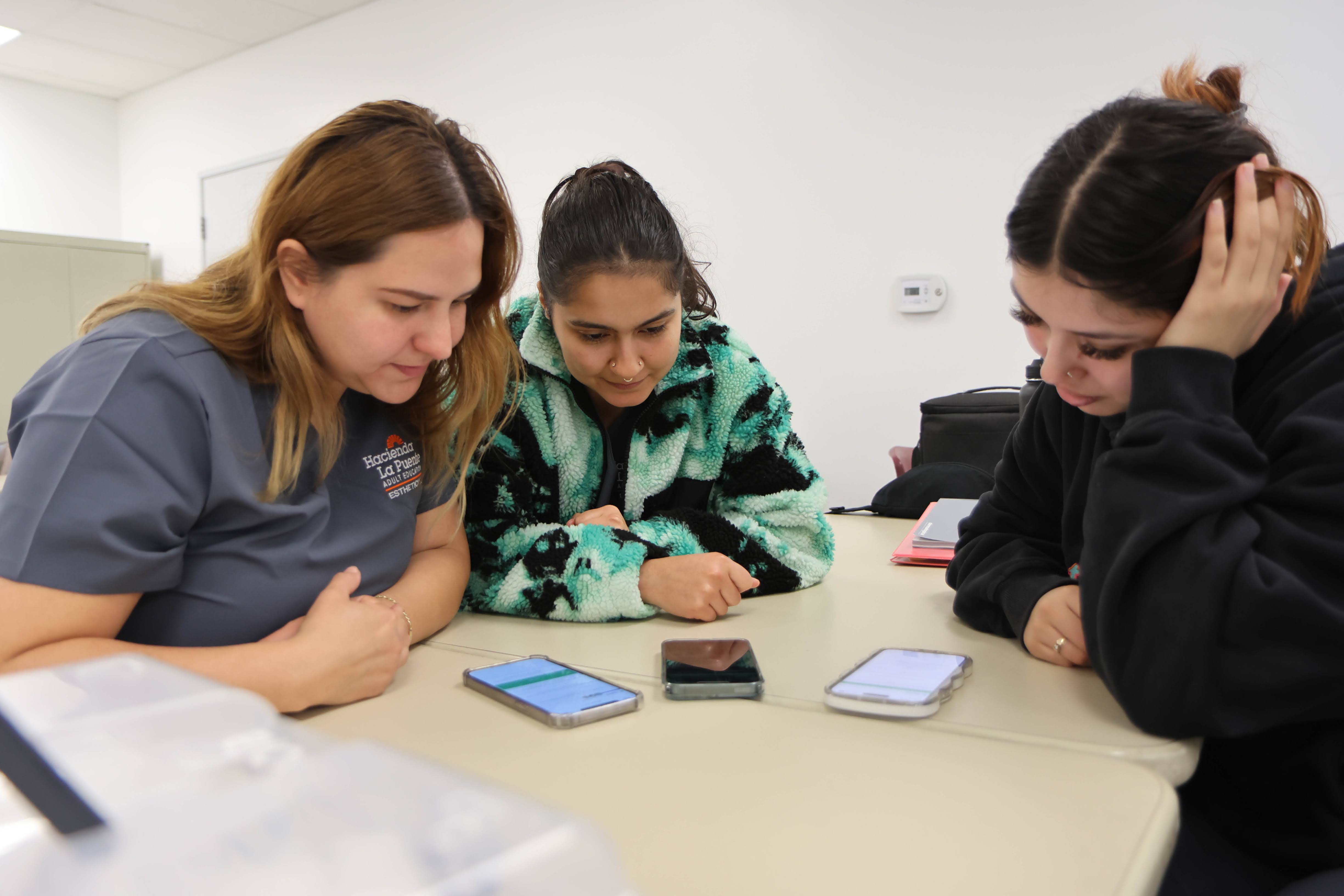
Students from Hacienda-La Puente Adult Education
How do I start creating an AI policy?
Begin with some guiding questions, such as:
- What is my goal for using AI in my classroom?
- Which standards can be addressed?
- Where do I add AI in my curriculum?
- How can AI help my students be successful learners?
With the standards, curriculum, plagiarism policy, and student needs in mind, start without expectations or consequences– these can be built as you observe your class and your students. Then, pick what you believe works to fulfill the needs of your students within your subject area. Create challenging assignments or questions to encourage students to refine their prompts in the AI generator.
Personal experience
I began exposing my English Composition students to AI as a class, so that everyone was on the same page about my expectations. I wanted to show students that they didn’t have to “sneak” AI into their assignments, since we were already incorporating it into class. I began with a project where students would introduce themselves to the class. First, they answered a warm-up question about whether they would be a superhero or supervillain, what their powers would be, and what costume they would wear. Then, I informed them that they would create a visual representation of their superhero in an AI generator, which I modeled. The students created and readjusted their prompts to fit their vision. We discussed what changes were made, why, and what the AI generator missed. To follow-up, we looked at plagiarism and citations and why AI needed citations. This process informed the policies I will create for the class, regardless of if they choose to use AI or not.
I hope these suggestions are useful as you begin developing a policy in your class. Eventually, your classroom policy can even be a model for a school-wide policy, should your school adopt one. Either way, the goal is to prepare your student for the future of technology, and it all starts with your classroom.